
BACK
The Curse of Narcissus: The Tragedy of the Echo and the Image
4
MIN READING
The Prophecy of the Mirror
The story begins with a prophecy that set the stage for a strange and lonely fate. When Narcissus was born, his mother, the nymph Liriope, asked the blind seer Tiresias if her son would live to a ripe old age. The seer’s answer was cryptic: "Only if he never knows himself". At the time, no biri this meant, for how could knowing oneself be a curse?
As Narcissus grew, he became a youth of such breathtaking beauty that every nymph and mortal who saw him fell instantly in love. Yet, Narcissus possessed a heart as cold as ice. He was arrogant and aloof, cruelly rejecting anyone who dared to show him affection. He lived in a state of total emotional isolation, protected by his own indifference.
The Grief of Echo
Among those who loved him was the mountain nymph Echo. Echo had her own burden: she had been cursed by the goddess Hera to never speak her own thoughts, only to repeat the last words spoken by others. One day, she spotted Narcissus wandering in a pathless forest and followed him, desperate to speak her love.
When Narcissus realized someone was following him, he called out, "Is anyone here?". Echo joyfully repeated, "Here!". He called, "Come!" and she answered, "Come!". But when she finally stepped out from the trees to embrace him, he pushed her away with disgust, crying, "I would die before I give you power over me!".
Heartbroken, Echo retreated into the deep caves of the mountains. She faded away from grief until her bones turned to stone and nothing remained of her but her voice—a hollow repetition of the world around her.
The Pool of Fate
The cruelty of Narcissus did not go unpunished. One of the many people he had rejected prayed to Nemesis, the Goddess of Retribution: "May he who loves not others, finally love himself and know the pain of unrequited passion". Nemesis heard the plea.
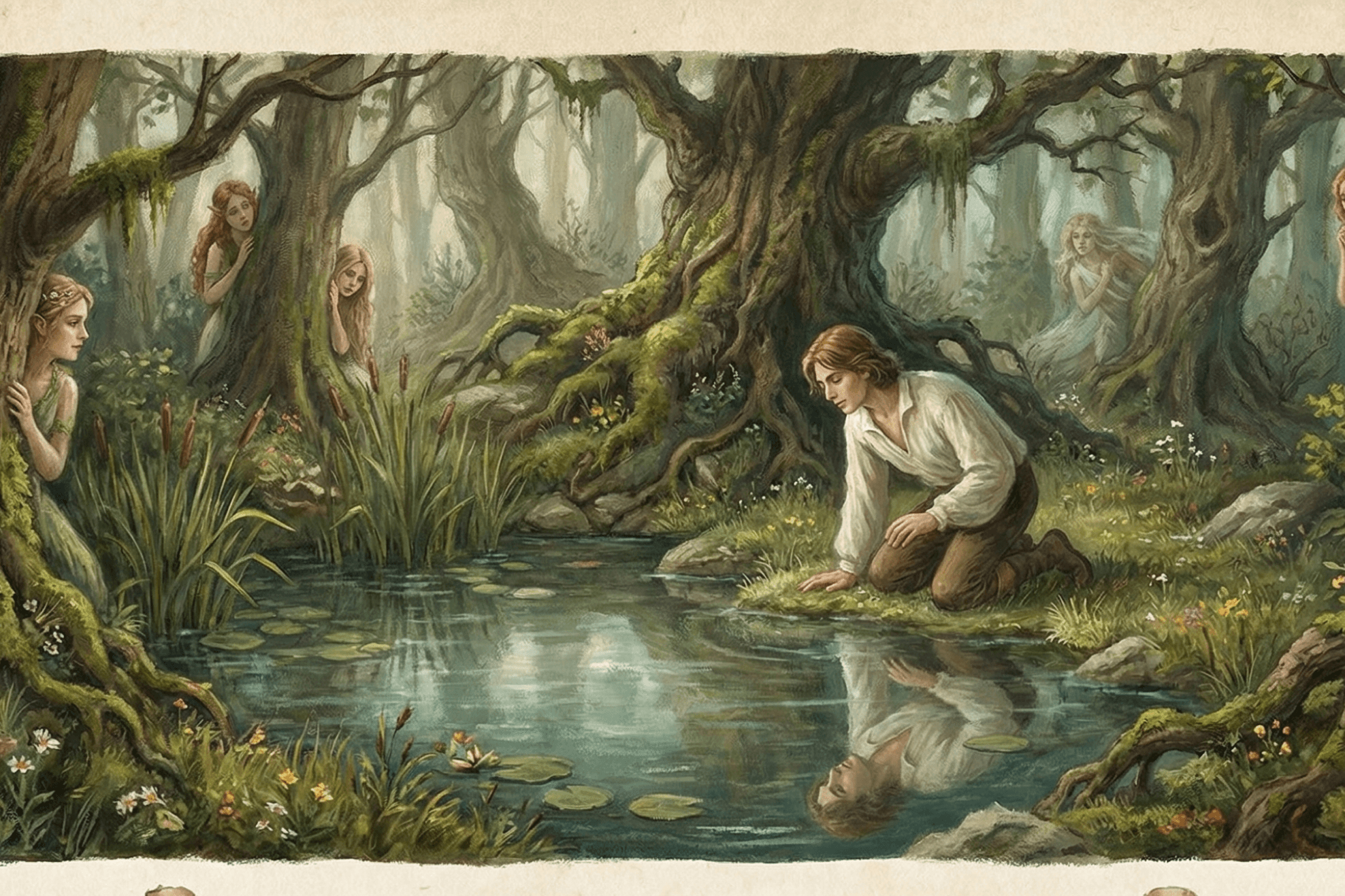
During a hunt, Narcissus came upon a pool of water that was silver-clear and undisturbed. No animal drank from it, and no branch ever fell into its surface. As he leaned down to quench his thirst, he saw for the first time his own reflection.
He did not realize it was himself. He fell in love with the eyes that looked back at him, the golden hair, and the perfect grace of the image in the water. The prophecy of Tiresias was finally fulfilled: Narcissus had "known" himself, but only as a surface image.
The Transformation into a Flower
For days, Narcissus remained by the pool, unable to eat or sleep. He reached out to touch the beautiful youth, but the water would ripple and the image would vanish. He spoke words of love, and the "Echo" from the nearby hills repeated them back, making him believe his reflection was answering him.
He realized at last that he was pining for his own shadow. "I am he!" he cried, "I burn with love for myself!". He could not leave, yet he could not possess what he loved. In his despair, he slowly withered away. When the nymphs came to bury him, his body was gone; in its place grew a flower with a gold center and white petals, leaning over the water as if still gazing at its own beauty: the Narcissus.
Reflections for the Soul
The story of Narcissus is a profound mirror for the modern psyche.
The Trap of the Image: Narcissus fell in love with a "Persona"—a flat, two-dimensional version of himself. This is the danger of living only for how we appear to others or even to ourselves, ignoring the deep, messy, and "un-perfect" parts of our soul.
The Silence of Echo: Echo represents the loss of one's own voice. When we spend our lives trying to please a "Narcissus" or seeking validation from those who cannot love, we lose our ability to speak our own truth.
The Still Pool: The water represents the unconscious. To look into it can be healing, but to get stuck on the surface is fatal.
Narcissus teaches us that true "self-knowledge" is not about admiring our reflection in a silver pool. It is about diving beneath the surface, facing the shadows, and finding a way to love the soul that exists beyond the image.