
BACK
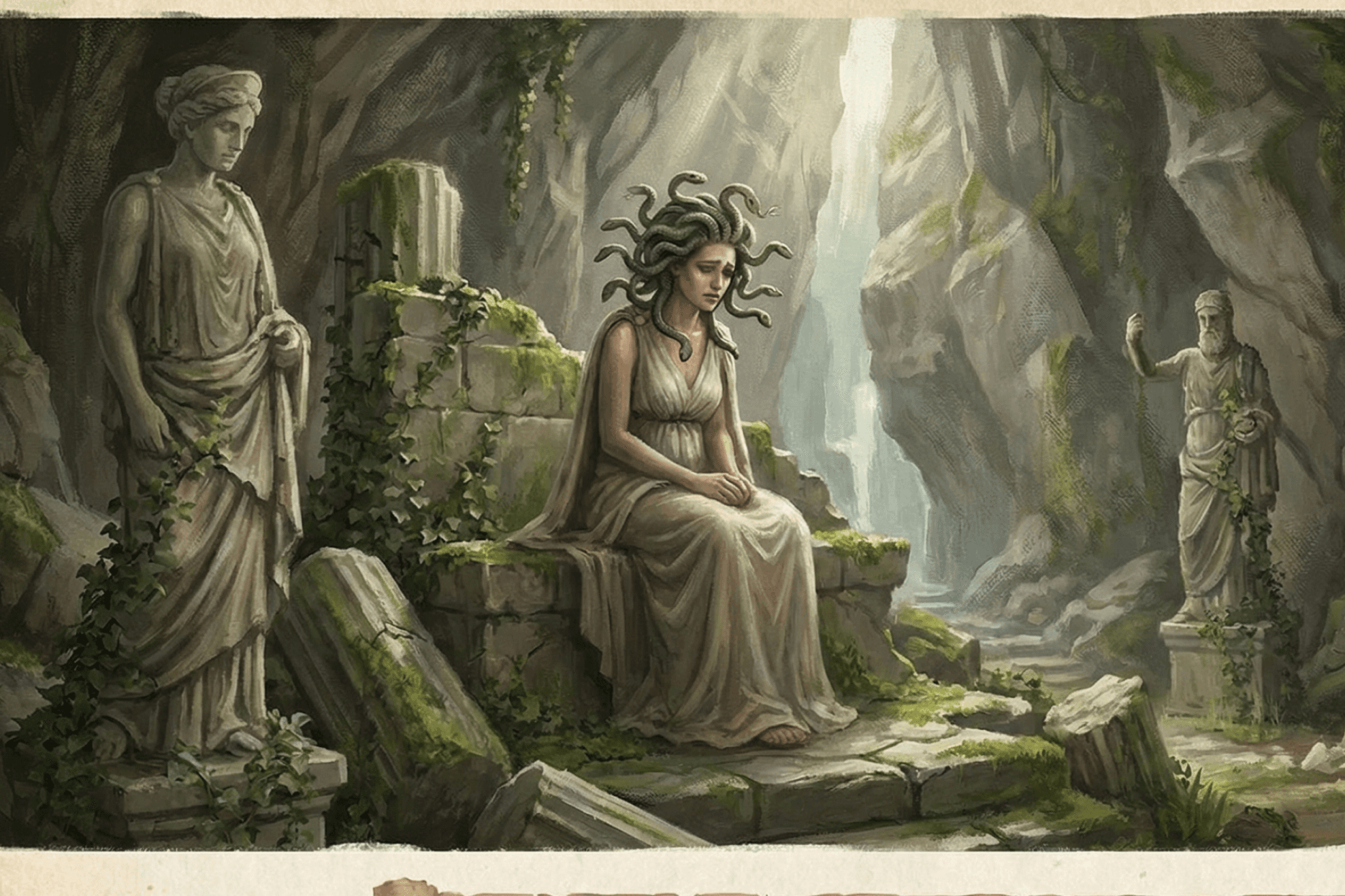
The Curse of Medusa
0
MIN READING
The Curse of Medusa: From Grace to Stone
The Maiden of the Temple
Long before she became the legendary monster of our nightmares, Medusa was a mortal woman of extraordinary beauty. She was a priestess in the temple of Athena, the Goddess of Wisdom. Medusa was known throughout the land for her grace, but her most captivating feature was her hair—long, flowing, and as radiant as the sun. As a priestess, she had taken a vow of celibacy, dedicating her life and her beauty to the service of the goddess.
However, her beauty was so profound that it did not only attract the admiration of mortals but also the unwanted attention of the gods. Poseidon, the God of the Sea, became obsessed with her. In an act of divine arrogance and cruelty, Poseidon cornered Medusa within the very temple she served—Athena’s sacred sanctuary—and violated her.
The Wrath of the Goddess
In the brutal logic of the ancient gods, the victim was often blamed for the desecration of sacred space. When Athena learned of what had happened in her temple, she did not punish the powerful Poseidon. Instead, her rage fell upon Medusa. Athena saw Medusa’s beauty as the root of the problem, a "distraction" that led to the temple's defilement.
Athena transformed Medusa into a creature of pure horror. Her beautiful, silken hair was turned into a nest of hissing, venomous serpents. Her skin became scaly and cold, and her once-gentle eyes were cursed with a terrible power: anyone who dared to look directly at her face would instantly be turned into cold, lifeless stone. Medusa was no longer a woman; she was the Gorgon, a symbol of isolation and terror, exiled to the edge of the world where no living soul could touch her without dying.
The Mirror and the End
For years, Medusa lived in the shadows, surrounded by the stone statues of those who had accidentally glanced her way. She became a creature defined by her trauma and the "mask" the world had forced upon her. Her story reached its conclusion when the hero Perseus was sent to claim her head.
Perseus knew he could not look at her directly, so he used a polished bronze shield given to him by Athena as a mirror. By looking only at her reflection, he was able to approach her while she slept. With one swift strike, he beheaded her. Even in death, her power remained; Perseus used her severed head as a weapon to turn his enemies to stone. Finally, Athena placed the image of Medusa’s head upon her own shield, the Aegis, using the monster she created as a symbol of protection and dread.
The Reflection of the Soul
The tragedy of Medusa is a story of how the world can transform a person's "grace" into a "curse" through trauma and judgment.
The Hair and the Snakes: The transition from flowing hair to snakes represents the shift from soft, vulnerable beauty to a defensive, dangerous exterior. It is the ultimate protective mechanism of a wounded soul.
The Gaze of Stone: To turn others to stone is to lose the ability to connect. When a soul is deeply hurt, it often builds walls so high that anyone who tries to get close is "frozen" out.
The Mirror of Perseus: The shield represents the necessity of "indirect" looking. Sometimes, our traumas are too painful to face directly; we must look at them through the "mirror" of art, mythology, or symbols to understand them without being destroyed by them.
Medusa reminds us that behind every "monster" or every "stony" exterior, there is often a story of a lost sanctuary and a beauty that was forced to grow scales just to survive the world.