
BACK
The Tragic Hero Oedipus
4
MIN READING
The Prophecy of Fear
The tragedy begins before Oedipus is even born. His father, King Laius of Thebes, receives a terrifying prophecy from the Oracle: his son will grow up to kill his father and marry his mother. In an attempt to cheat fate, Laius orders the newborn's feet to be pierced and bound, and the infant left on a mountainside to die.
However, a compassionate shepherd saves the baby and takes him to the King of Corinth, who raises him as his own. He is named Oedipus, meaning "Swollen Foot."
The Crossroads of Fate
As a young man, Oedipus hears the same prophecy. Believing his Corinthian parents are his biological ones, he flees the city to protect them. On his journey, at a narrow crossroads, he encounters an arrogant man in a chariot. A dispute breaks out over who has the right of way, and in a fit of rage, Oedipus kills the man. Unknown to him, the man was King Laius—his biological father.
The Riddle of the Sphinx
Oedipus eventually arrives at the gates of Thebes, which is being terrorized by a Sphinx, a monster with the body of a lion and the head of a woman. She refuses to let anyone pass unless they solve her riddle: "What walks on four legs in the morning, two legs at noon, and three legs in the evening?"
Oedipus provides the correct answer: "Man" (who crawls as a baby, walks as an adult, and uses a cane in old age). Defeated, the Sphinx throws herself from the cliffs. The grateful people of Thebes crown Oedipus as their King, and he marries the widowed Queen, Jocasta—his biological mother.
The Painful Truth
Years later, a plague strikes Thebes. Seeking a cure, Oedipus vows to find the murderer of the former king, Laius. His relentless search for truth leads him to the horrifying realization: he is the murderer he seeks. He has fulfilled the prophecy he tried so hard to avoid.
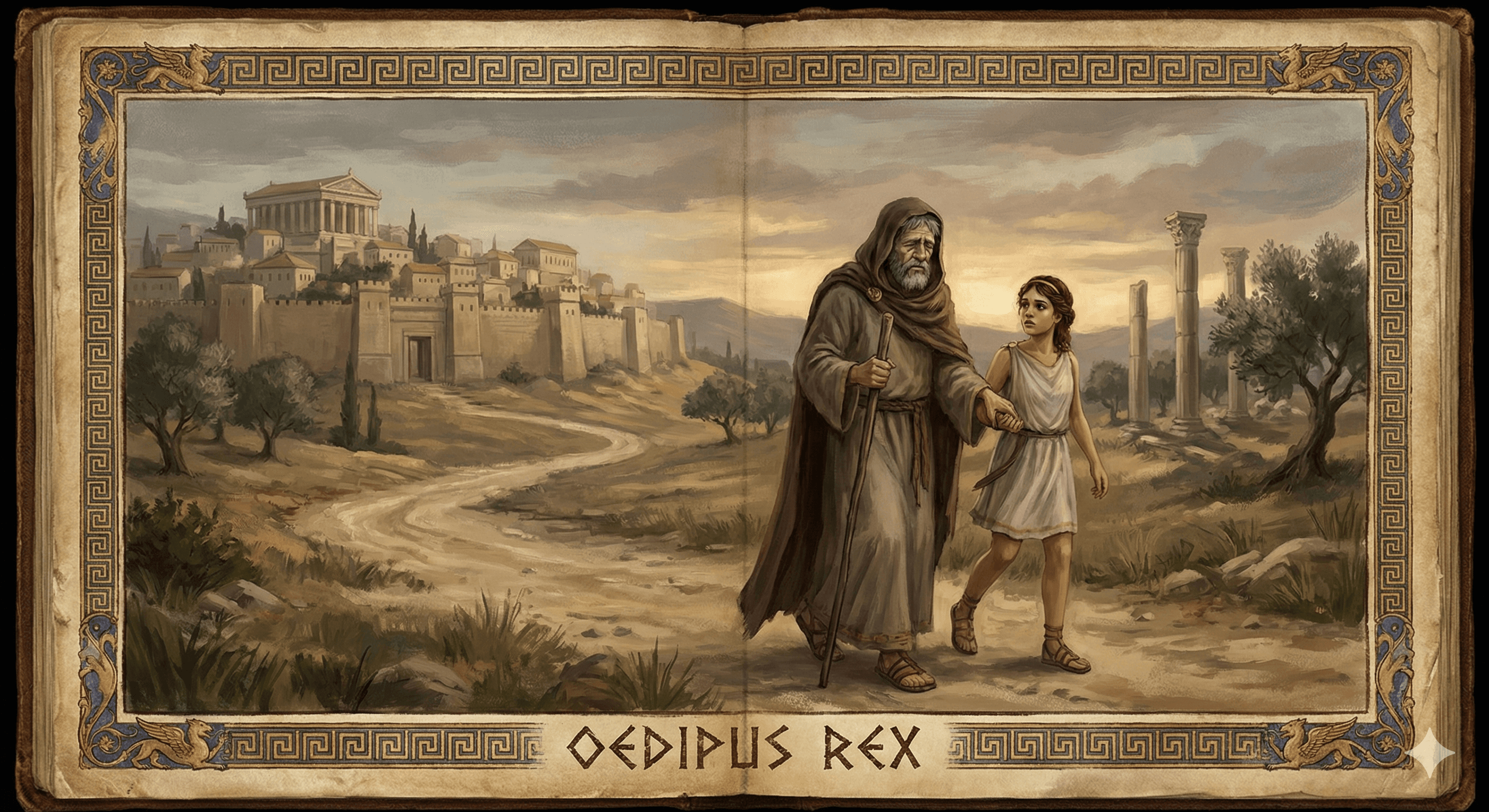
Upon discovering the truth, Jocasta takes her own life. Oedipus, unable to bear the sight of the world or the children he fathered through his mother, blinds himself with the pins from her robe. He leaves Thebes as a wandering, broken exile, a man who solved the riddle of humanity but could not solve the riddle of his own existence.
The Psychological Echo: The Oedipus Complex
Oedipus eventually entered the world of psychology through Sigmund Freud, who coined the term "Oedipus Complex".
Freud used this myth as a metaphor for a stage in childhood development. He theorized that children often feel a subconscious desire for the parent of the opposite sex and a sense of rivalry with the parent of the same sex.
In a broader sense, the "Oedipal" struggle in psychology represents our battle with Fate and the Unconscious. It tells the story of how the things we run away from often meet us at the crossroads, and how the search for "Who am I?" can be both liberating and devastatingly painful.